Graphic Facilitation needs sticky notes… lots of them
When people think of using visuals in business settings they can sometimes mix up the terms graphic recording and graphic facilitation, but they involve two quite different activities.
The reasons are rooted in how graphic recording has become a popular and highly visible way to galvanise meetings and events. But in truth it is an offshoot of the practice of graphic facilitation. Graphic facilitation can really impact what businesses are doing on a deeper level.
Understanding this difference is critical for business leaders, facilitators, HR business partners and more who need to run high impact workshops
“Literally no one ever uses the term graphic recorder or graphic facilitator in a business workshop setting. They don’t know or care about the difference. They will listen to you and pay attention if you have the presence to get a room in order, have an interesting template to fill in and have seen you draw something. The irony is there IS a difference.”
What IS the difference between Graphic Facilitation and Graphic Recording?
The critical difference is the one is actively intervening in the session, the other is passively listening and capturing the session.

The real skill is being able to do both…
Graphic Recording (Live Illustration or scribing):
A graphic recorder is a visual note taker. They are in the room listening and synthesising the information into visual maps in real time. We use ipads or pens and boards. It is overlooked but this practice supports the facilitation of the event and can be a vital tool.
A visual summariser, listener and observer role
Passive role capturing content in the room but not centre stage
Subtle interaction with the group - saying it with images
Creating an in the moment visual, and post event record
Best deployed at conferences, keynotes and crucially supporting workshops
Graphic Facilitation:
A graphic facilitator uses visual structures to lead a session and moderate conversations. At the front of the room using large templates, post-it notes and running exercises. Their role is to guide participants in thinking through problems and ideas, manage the dynamics of the group and help people towards a goal.
A role as the process leader and group moderator
Found in front of the room guiding the group
A highly interactive role running exercise, asking questions and prompting activity
Their goal is to help teams align, define visions and reach consensus
What makes a Graphic Facilitator?
Graphic facilitation can trace its routes to the San Francisco Bay area in the 1970s. They use visual language as a tool. As a result the drawing itself is secondary, its part of the process, but it is simple, functional and direct. One of the reasons the style blends so well into the world of cartoons. The skills required go beyond drawing, they have to be able to understand group dynamics, consider how systems work, how businesses and organisations function and be ready to listen and respond to an ever shifting dynamic. One of the great names in Graphic Facilitation is David Sibbet who has written on it extensively.

Photos of sticky notes always look awful
How Graphic Facilitation Works
Like other forms of facilitation it’s a process that needs work before and after the event. But the magic happens on the day.
Pre Workshop Design - there are a huge number of templates, formats and systems available. The goal of the meeting and the needs of the stakeholders guide which are used, and sometimes totally unique ones are made
Space for visuals - the physical location and design is important. Can people move around, will they sit or stand and is there space to work on walls or will people be at tables. This can be overlooked but graphic facilitation is about getting people active physically as well as mentally
Core Facilitation Skills - balancing giving people what they want, space to figure things out and rigorous time keeping
Synthesis and Alignment - the visual aspect of the process, using movable post its, looking at information spatially arranged helps people see patterns, prioritise information and agree on actions
Visual Support - a graphic recorder with their own space to draw can support the session as they create a summarised map of the post its and scribbles made by the group, this is where an instant summary comes into its own
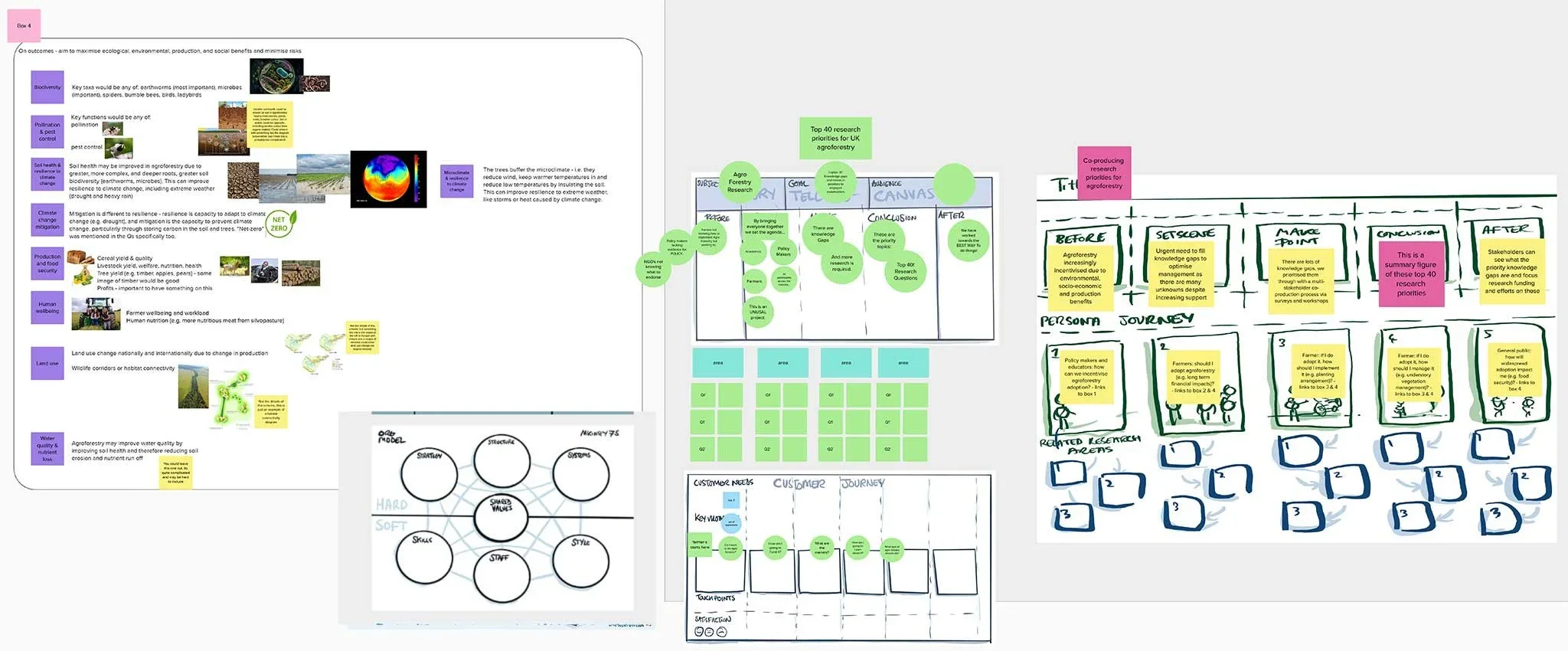
Templates can be selected from a huge array of sources, or custom designed for the job in hand, and it can all be done virtually too
Why do people use Graphic Facilitation
Technically writing ideas on a flip chart and reporting back to the room is graphic facilitation because you have a flip chart. It is also the single worst and most uninspiring way to get results from people. Our brains are capable of so much more when they are properly stimulated, and visuals are processed tens of thousands of times faster than text.
Here are four reasons why graphic facilitation is better than a regular meeting.
No more circular debates - having things mapped out on walls, prioritised and contextualised stops people going round in circles
Neutralises hierarchy - a C-Suite executives sticky note is mixed in office juniors, the seniority flattens in favour of collaborative problem solving
Enhanced retention and engagement - combining auditory and visual inputs boosts memory and retention, the process also allows the introverted to have a voice via sticky notes and other methods
Builds shared ownership - everyone being able to contribute and seeing their words become part of the roadmap, strategy or vision creates real buy in for the post workshop implementation

Hierarchies are replaced with a flat vision of the information allowing clear progress
Who benefits from corporate workshops?
Graphic facilitation delivers a high ROI across several types of workshop.
Executive Leadership & Strategy Teams need to polish and roll out their strategies, cascade visions and goals to the organisation, and align in doing it.
HR & Change Management Leaders need to align on transformations, restructures and culture shifts - and they need to reach and engage all levels of an organisation in doing so
Cross Functional Innovation Labs need to break down department silos and rapidly prototype business models, design thinking and graphic facilitation are a match made in heaven
Product & UX Design Teams who need to map customer journeys, engage with customers and external stake holders and focus groups where they want to access hidden insights
What skills do you need to be a Graphic Facilitator?
A scribe will be able to keenly listen, draw fast and be able to understand any subject put in front of them. Not every graphic recorder, scribe or live illustrator is a graphic facilitator. It’s a complex expanded skillset.
Process facilitation expertise - you need to be willing to stand up in front of people, and able to get them to do what you ask
Pre event discovery - co-design of a graphic facilitation session is as important as the session itself
Business literacy - knowledge and experience of multiple sectors is always handy
Adaptability under pressure - dynamics in sessions can shift, and knowing when to say ‘trust the process’ or pivot is a huge skill
Dual delivery modes - being in person is one thing, but all of this can be done remotely in Miro or Mural is needed
Actionable post event assets - being able to provide reports and summaries of these events ready for distribution
“After drawing in thousands of meetings of workshops I have found myself facilitating them. The interesting thing is that a well run graphic facilitation session is easier to draw, for me developing a graphic facilitation skillset has been a way to do the best drawing possible. When we are asked to do a particularly complex Rich Picture often I will facilitate a workshop to get the information that needs to be drawn. The process in itself helps clients rework their ideas. The trick then is to draw something that makes it all look simple.”
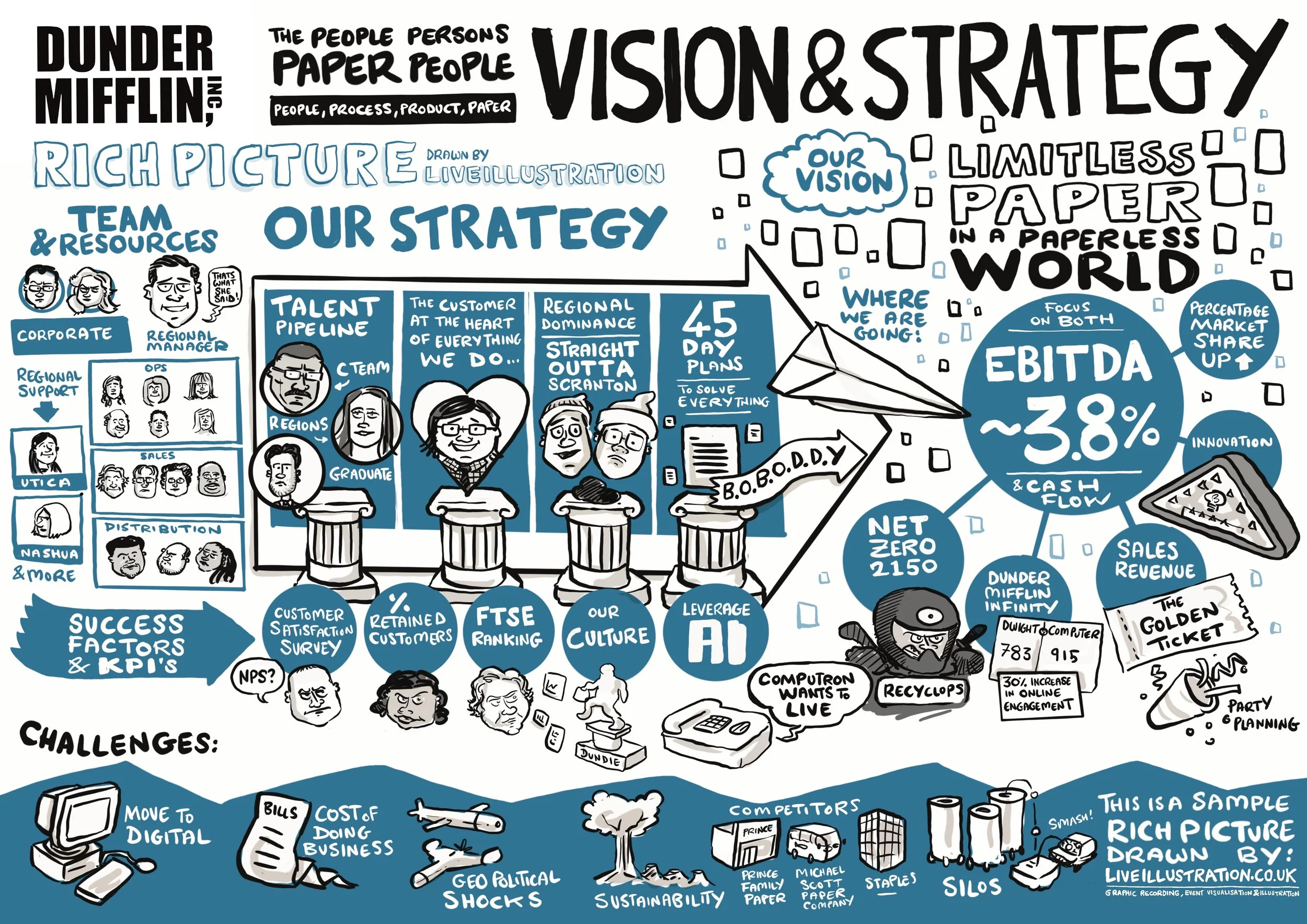
The Dunder Mifflin Rich Picture
One of the drawbacks of visualising company transformations, strategies and operating models is you don’t get to show them off to the outside world as they are for internal audiences. But we do have one we can share, which was made via a graphically facilitated process, and you can see it here. And you can read a little on the process in this blogpost, where you can how graphic facilitation can lead into a polished visual.